


Dear Reader,
When you hear the word “sustainability,” what comes to mind?
For many people, the first answers are climate, energy, or food systems. It is far less common to think of jazz clubs, a reed ceremony, or WhatsApp voice notes. Yet over the last three years, those are the kinds of places our work keeps returning to.
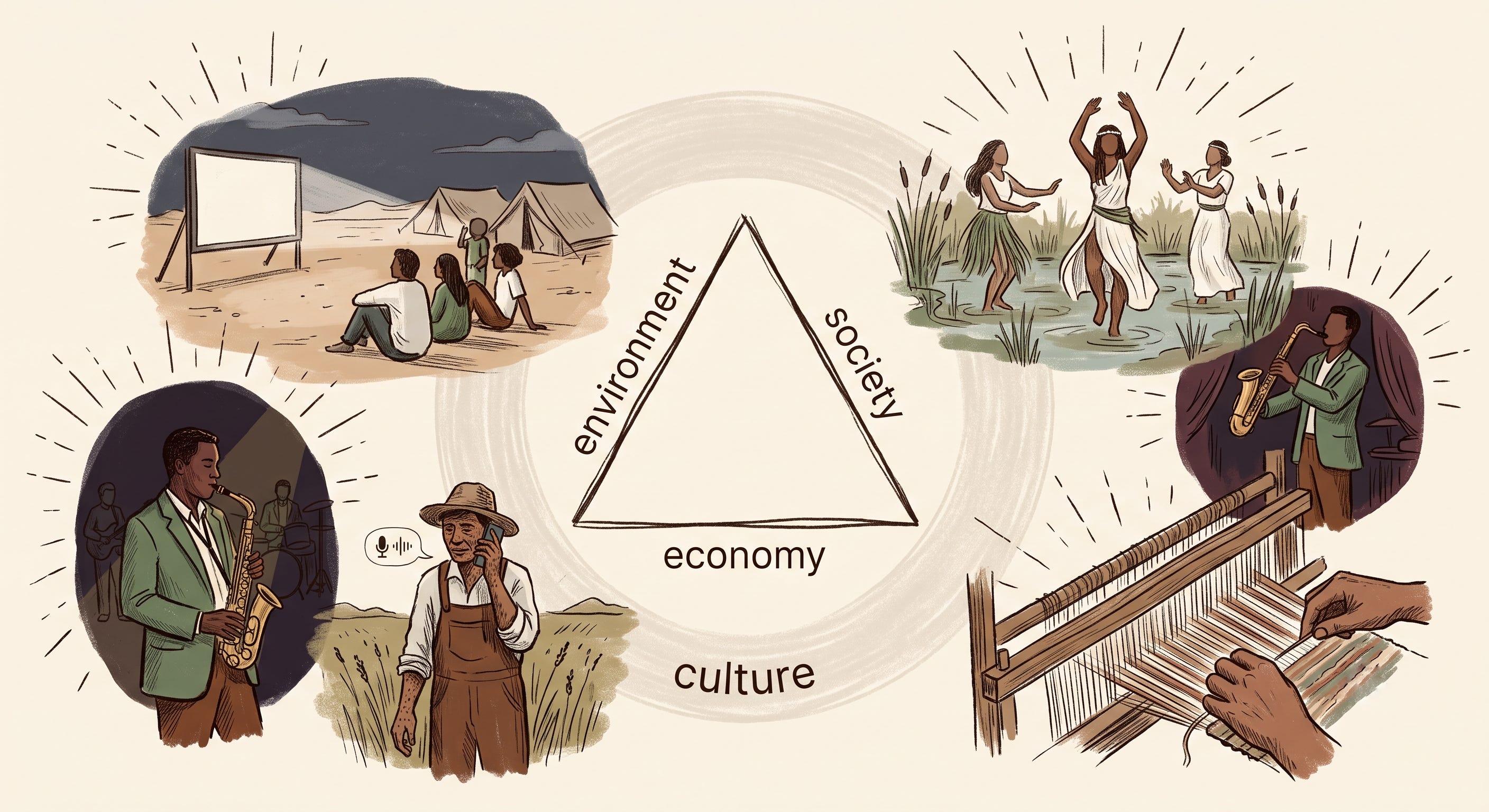
When we launched Susinsight, we leaned on a familiar structure. Sustainability was usually divided into three parts: environment, society, and the economy. That frame helped us organise our early reporting, commission stories, and make sense of the many topics we wanted to cover. It gave us language to speak to researchers, policymakers, and organisers who were already working inside that triangle.
Slowly, the reporting began to push back.
As we commissioned stories and reviewed pitches, we noticed a cluster of stories that did not sit comfortably in any of the three boxes. If we tried hard enough, we could file them away. A piece about language became “social”, one about fashion slotted into “economic”, and a report on a traditional practice could be treated as an environmental case study. On paper, the labels worked. In reality, something felt off.
What linked these stories was not only their subject but the way people in them used culture to navigate change. Not culture as decoration or nostalgia, but as daily practice: how communities remember, teach, celebrate, and plan. The more we paid attention to this layer, the harder it became to treat it as background context.
That realisation did not arrive through a single breakthrough. It crept in through repeated encounters. In Western Sahara, a film festival inside refugee camps turned out to be an archive in motion; a place where younger Sahrawis learn to record their own history and keep a sense of nationhood alive. In Eswatini, a reed ceremony that many outsiders know only as a spectacle revealed itself as a system for passing on wetland knowledge and social responsibilities across generations. In Cape Town, jazz clubs and festivals that once held space for resistance now sustain an economy where music carries memory, jobs, and more sustainable tourism in the same rhythm.
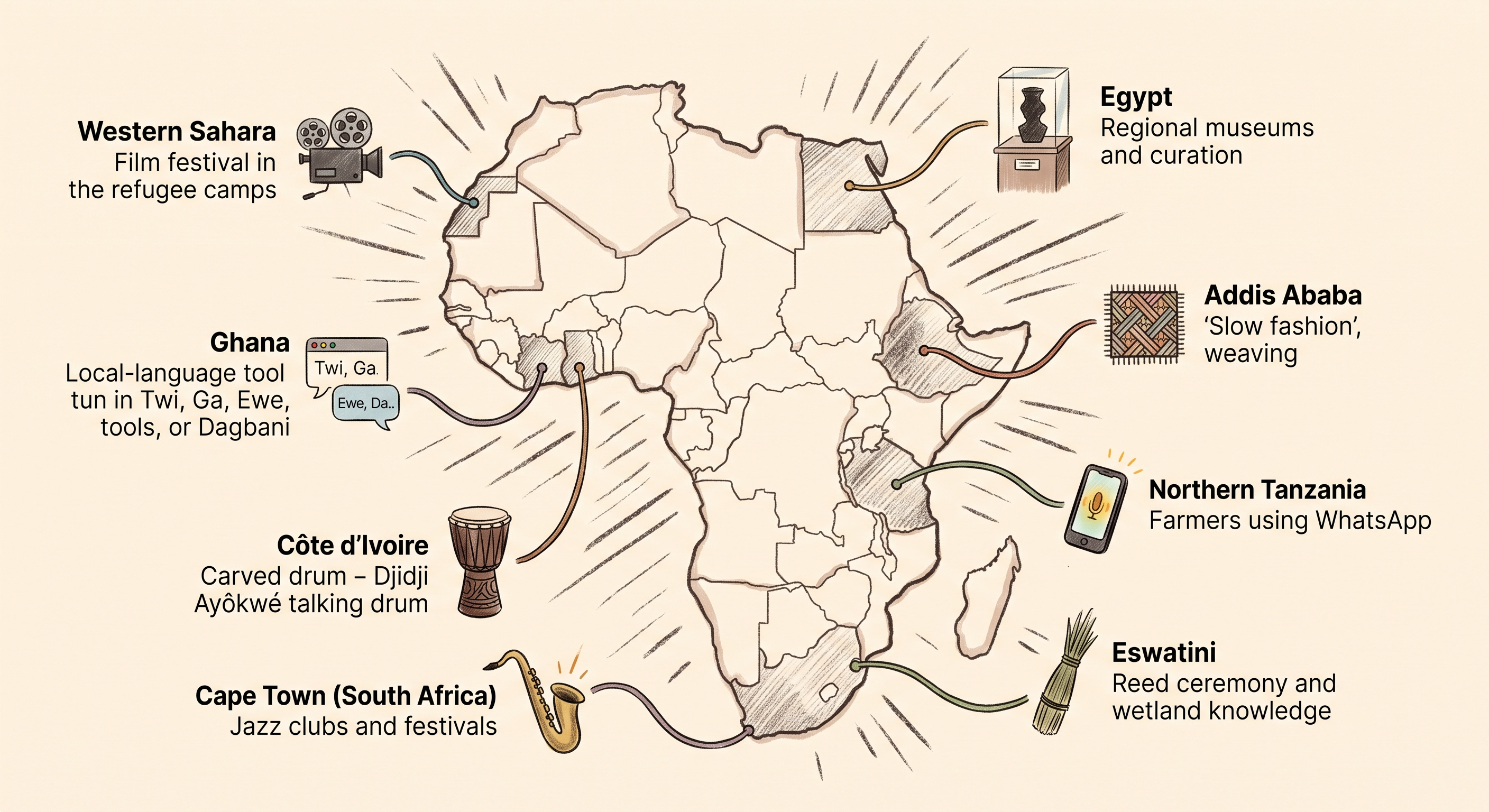
Elsewhere, the pattern took a different shape. In and around Addis Ababa, the story of “slow fashion” was not just about exports or trend cycles. It was about weavers and designers who carry techniques learned in childhood into present-day workshops, adapting patterns for new markets while holding on to methods that anchor them in place. In northern Tanzania, farmers were not treating WhatsApp as a neutral app. They were bending it to match existing habits of asking for advice and learning in a language that felt familiar.
We saw similar threads in efforts to build tools in Twi, Ga, Ewe, and Dagbani in Ghana, or in the quiet work of curators and staff in regional museums in Egypt. Decisions about which languages appear on a screen and whose objects are placed in glass cases turned out to be decisions about whose knowledge survives and whose memories are made visible. Most recently, in our story on the Djidji Ayôkwé talking drum in Côte d’Ivoire, we followed how restitution is not only a legal process between governments but a question of how the Ebrié people revive a drum’s role in communication and collective memory after a century of silence.
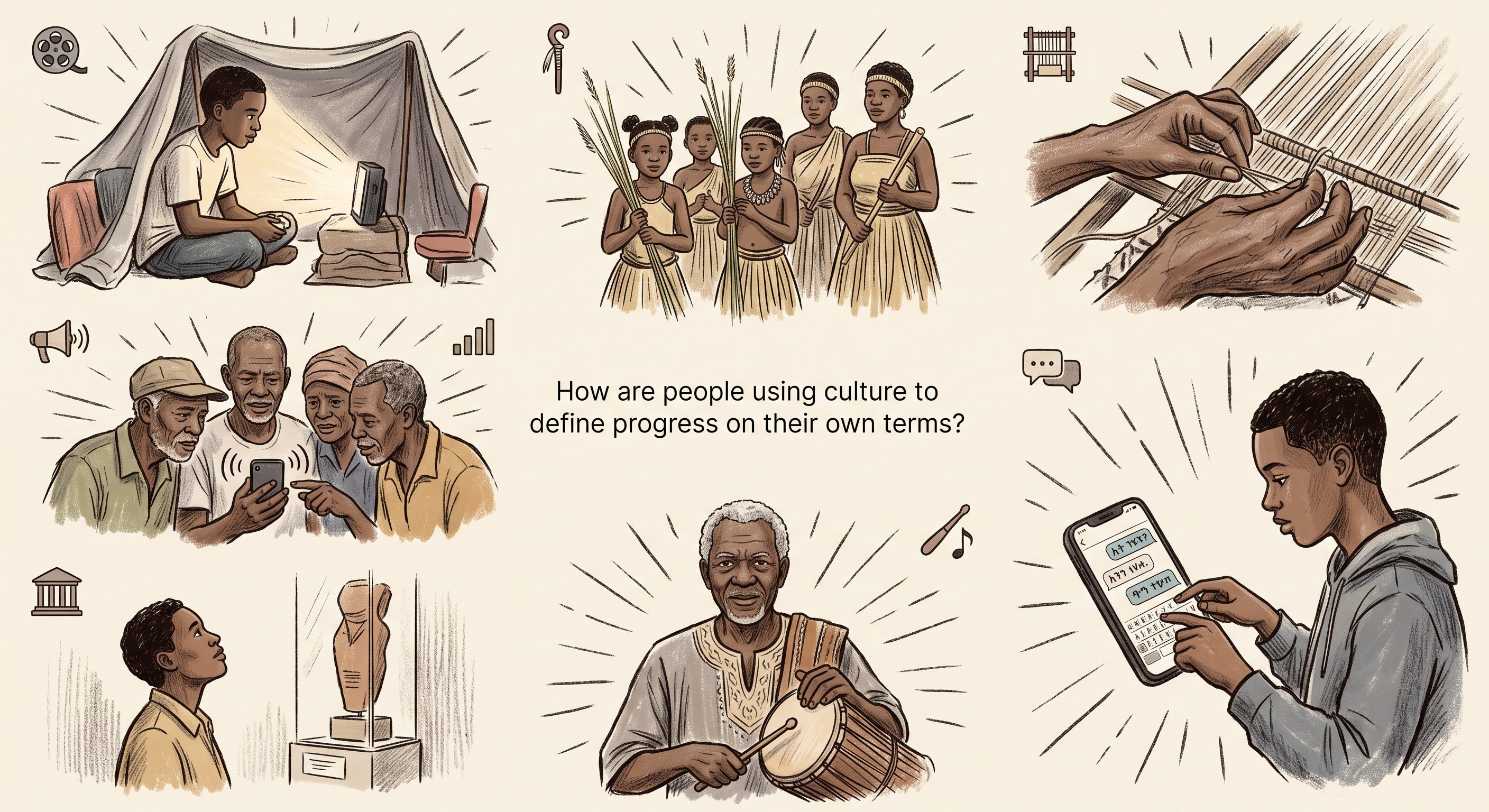
Taken one by one, these assignments could be filed under education, technology, or heritage. Taken together, they pointed us back to a shared question: how are people using culture to define progress on their own terms?
That question has changed how we work as editors.
It shapes which story angles catch our attention and which ones we set aside. When we learn about a new idea, we now listen for the local logic sitting under the surface: the proverb repeated at a community meeting, the informal rule about who speaks when, the song that appears every year at the same festival, and the way a digital tool is quietly adapted to fit a neighbourhood rather than a product manual. We ask writers to stay with those details a little longer before reaching for global language.
Over time, this shift in focus became visible on the site. We created the Cultural Stories column to make room for pieces that begin with questions of language, memory, music, craft, belief, or belonging, and then follow where those questions lead. Often, the path runs straight into areas usually marked as “development”: jobs, education, health, technology, or conservation. The route is simply different.
A story that starts with a film festival ends up being about how a displaced community keeps control over its own narrative. A piece that opens in a reedbed becomes a study in how ecological care and social norms grow together. An article that begins with textile patterns turns into a record of who gets to work and which skills are passed on. A report on voice notes shows how farmers trust advice that comes through familiar channels long before they trust a distant programme. A piece that begins with a carved drum in a Paris museum becomes a story about restitution and how heritage shifts from being stored to being used again.
We still use the language of environment, society, and economy. It remains useful, especially when we need to compare experiences across regions or speak to readers who work inside institutions built around those categories. What has changed is our sense of what sits underneath. Culture keeps appearing as the place where people quietly negotiate what those three words will mean in practice.
For some, progress looks like a young filmmaker in a refugee camp screening a film in her own language. For others, it is a chief agreeing to adjust a long-standing rule so that more girls can participate in a ceremony. It might be a weaver in Addis earning a steady income without leaving a craft that ties her to family and place, or a teenager in northern Ghana asking a chatbot a question in a language spoken at home. It might be a child in Aswan who, for the first time, sees their community centred in a museum display rather than placed at the edge, or an Ebrié elder in Abidjan hearing the Djidji Ayôkwé sound again and recognising a voice that had been missing.
You can measure parts of these changes with indicators and targets. You can count jobs, visitors, and devices. But if you ignore the cultural ground they grow from, the numbers will not tell you why certain efforts endure while others fade.
That is the main lesson three years of reporting have taught us. Frameworks help; they give structure to complex subjects. At the same time, the stories themselves sometimes insist on a different entry point. For us, that has meant treating culture not as a softer layer around “real” development, but as one of the primary ways people across Africa understand and reshape their worlds.
In the months ahead, you will keep seeing this perspective across Susinsight. Some pieces will sit clearly in business or policy. Others will live in Cultural Stories. Many will touch more than one space. What they share is an interest in how people carry knowledge, values, and memory into decisions about land, work, technology, and daily life.
We are grateful you have been reading with us through this shift. Your responses, questions, and reflections have helped sharpen our own. As we continue to report, edit, and commission, we will keep returning to this simple, unsettling, and often hopeful observation: culture is not just where the story begins; it is often where the meaning of “development” is being argued, protected, and quietly rewritten.
Thank you for being part of that conversation.
With appreciation,
Adetoro Adetayo & Tomi Abe
Co-Publishers & Editorial Directors, Susinsight
🔍 More for You to Explore
If you liked this inside story, don’t stop here.
💬We’d love to hear from you.
How has Susinsight shaped how you see Africa’s future? Your feedback helps us grow, question, and dig deeper.
👉🏽 Share your thoughts
🗣️ Got something worth sharing?

Our new column, Stories of Us, is a space for everyday Africans and diaspora voices to share real moments, tough decisions, big dreams, and unexpected lessons.
Learn more and share your story
📈 Want to see the numbers?
Explore Susdata for key metrics on Africa’s progress toward sustainability - social, economic, and environmental.
📚 Need a clearer picture?
Our Glossary breaks down the terms and concepts shaping Africa’s development journey.
🌍 Looking ahead?
See the Top Sustainability Trends of 2025 we’re watching and why they matter for your future.
🎉 Quick History Fix:
Did you know when your country gained independence? Our African Independence Dates list is more than just trivia; it’s the backdrop of our shared story.
🙌🏾 Let’s Stay Connected
We’re more than a platform. We’re a movement of storytellers, analysts, researchers, writers, and everyday citizens who believe in a better future for Africa.
Follow us on Instagram, X/Twitter, LinkedIn, Facebook, Pinterest, WhatsApp, YouTube, TikTok, and Flipboard.
This update falls under the “Inside Stories” column in our newsletter.
Note: All images used in this letter are proprietary to Susinsight.com and are not for use or reproduction without permission.